

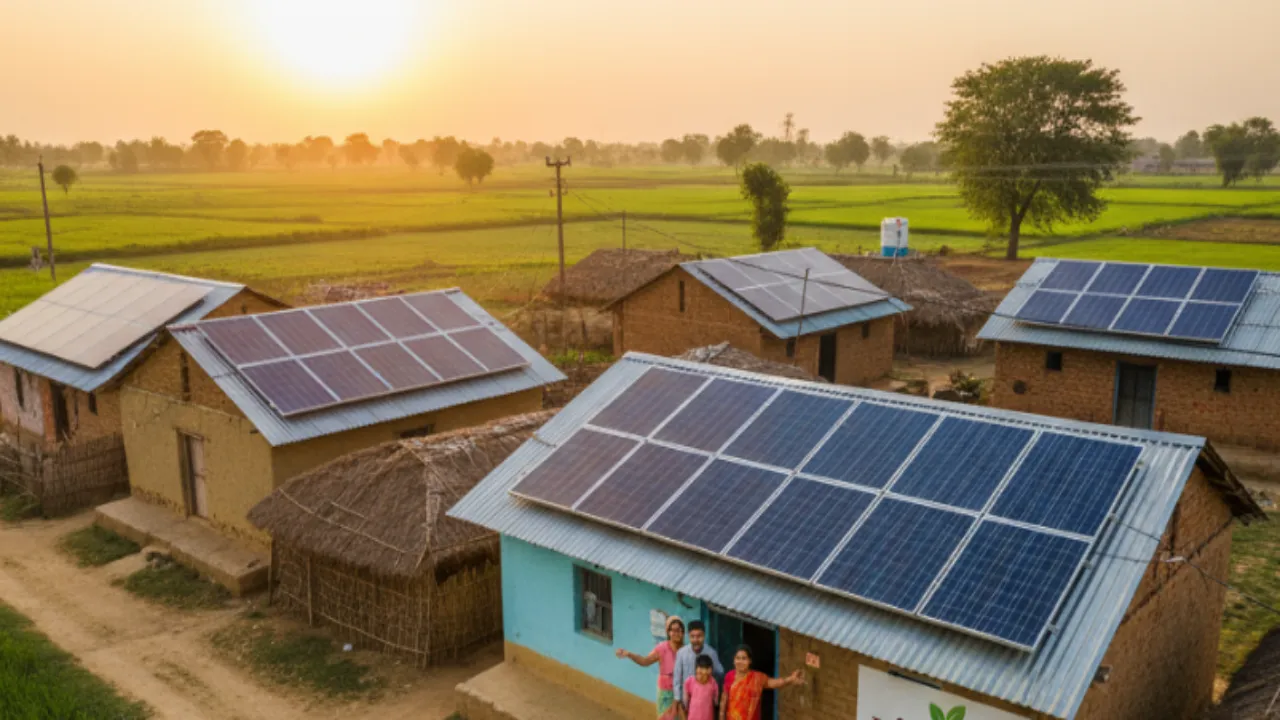
Why 2025 is the year to go solar
Rural households finally have a clear, funded pathway to cut power bills with rooftop solar—thanks to the PM Surya Ghar: Muft Bijli Yojana and allied state subsidies. The central outlay runs through FY 2026–27 and targets 1 crore homes, with direct subsidy to bank accounts and simplified approvals through the national portal. For villages with unstable supply or frequent cuts, a small 1–3 kW system can stabilize essentials like lights, fans, TV, and even small appliances while shrinking the monthly bill.
Who is this for
If the house has its own roof (pucca or reinforced shed), a domestic meter in the family’s name, and basic day-time consumption, rooftop solar is a fit. Tenants can apply with owner consent. Farmers with high irrigation loads should also explore PM-KUSUM for solar pumps—good for reducing diesel dependence and earning from surplus power in some states.
Subsidy slabs at a glance (PM Surya Ghar)
| System size | Approx central subsidy |
|---|---|
| 1 kW | ₹30,000 |
| 2 kW | ₹60,000 |
| 3 kW | ₹78,000 (cap) |
Many states add an extra 10–30% subsidy on top; special-category states may get higher support. Households can offset up to 300 units/month, depending on capacity and usage. Banks are offering concessional loans to minimize upfront burden.
Real savings for a rural family
- A 2 kW grid-tied system can generate roughly 6–8 units/day in good sun. That’s about 180–240 units/month—enough to slash typical rural home bills drastically.
- With subsidy, net upfront can drop by ₹60,000 on 2 kW or ₹78,000 on 3 kW, translating to payback in 3–5 years in many DISCOMs, faster where tariffs or diesel genset use is high.
- Net metering lets households bank daytime surplus and draw power at night, reducing the need for costly batteries for most users.
Step-by-step: How to apply
- Register on the National Rooftop Solar Portal with consumer number, DISCOM, and address. Verify mobile and KYC details.
- Choose an empanelled vendor shown for the DISCOM area. Ask for site visit, shading analysis, and a system design (1–3 kW is common for homes).
- Submit online application for technical feasibility. Wait for DISCOM’s nod and proceed with installation by the chosen vendor.
- Post-installation, vendor will request inspection, net meter installation, and commissioning. Subsidy is credited to the beneficiary’s bank after approval.
For farmers: PM-KUSUM quick take
- Standalone solar pumps up to 7.5 HP with about 60% subsidy (shared by Centre and State). Farmers typically contribute ~10%, rest via loans.
- Solarise existing grid-connected pumps to use solar by day and sell surplus to DISCOMs at pre-fixed tariffs.
- Decentralized plants (up to 2 MW) can be set on barren land near substations, with power sold to the grid—an extra income stream for FPOs/panchayats.
What to buy: simple checklist
- Panels: Tier-1 BIS certified mono PERC/TopCon, 400–550 W modules for compact roofs.
- Inverter: MNRE-approved string inverter with DC/AC surge protection and remote monitoring. For frequent outages, consider a hybrid inverter with a small battery backup for lights/fans.
- Mounting: Hot-dip galvanized structures with wind certification; proper earthing and lightning protection are non-negotiable.
- Warranty: 25-year performance on panels, 5–10 years on inverter; ensure local service support.
Net metering and billing basics
- Monthly bill shows imported vs exported units; only the net balance is charged as per state policy. Fixed charges may still apply.
- If exports exceed imports, credits carry forward as per state rules; settlement frequency differs by DISCOM.
- Use the portal/app to track daily generation; raise service tickets early if output dips or the inverter shows faults.
Roof and safety tips for village homes
- Structure check: Get a basic load and seepage assessment; avoid drilling where the slab is thin or damp.
- Animal-safe cabling: Run DC cables in UV conduits; keep junction boxes elevated and weather-sealed.
- Earthing: Two separate earthing pits (DC and AC) plus lightning arrester for open fields/high roofs.
Avoid these common pitfalls
- Unempanelled vendors: May risk subsidy rejection; confirm vendor status on the portal.
- Oversizing: Don’t exceed sanctioned load without DISCOM approval; redesign after a 12-month usage review.
- Battery overkill: Grid-tied with net metering works for most homes; add batteries only where outages are long and frequent.
5-minute budgeting snapshot
| Item | 2 kW | 3 kW |
|---|---|---|
| Typical turnkey (pre-subsidy) | ₹1.2–1.5 lakh | ₹1.7–2.2 lakh |
| Central subsidy | ₹60,000 | ₹78,000 |
| Likely net outlay | ₹60k–90k | ₹92k–1.42 lakh |
| Monthly units (avg) | 180–240 | 270–360 |
How to maximize savings
- Run heavy loads (mixie, washer) in sunshine hours to consume generation directly.
- Replace old fans/bulbs with BLDC and LED; the same solar output now covers more appliances.
- Keep panels dust-free; a fortnightly rinse in dry months lifts output 2–5%.
YouTube: Rooftop solar for rural homes
Useful links (official portals)
- National Rooftop Solar Portal: pmsuryaghar.gov.in
- PM-KUSUM Portal: pmkusum.mnre.gov.in
Bottom line
With central subsidies up to ₹78,000, state top-ups, and easier net metering, rural families can finally bring down electricity costs in 2025 without complicated tech. Start small at 2–3 kW, pick an empanelled vendor, and let the sun handle the bills while the household enjoys dependable power for everyday needs.

0 Comments
No comments yet. Be the first to share your thoughts!